



Behind every gleaming facade of the world's most ambitious construction projects is a workforce handling one of the most hazardous materials in manufacturing. This is their story and why cut protection has never mattered more.
A Region Built on Glass
Look at the skyline of Dubai. Picture the vast, glass-clad corridors of NEOM's The Line stretching across the Saudi desert. Consider Cairo's New Administrative Capital rising from the ground at extraordinary speed. The Middle East is in the grip of a construction era unlike anything the world has seen before, and glass is at the centre of it.
The numbers are striking. According to market research, the Middle East glass market was valued at $2.56 billion US Dollars in 2024 and is forecast to reach $4.33 billion USD by 2032, growing at a compound annual growth rate of 6.8%.
The Middle East and Africa Flat Glass market alone, arguably the industrial workhorse of city skylines, architectural facades, exterior windows, and solar energy panels is expected to grow at 7.5% CAGR through to 2030. This is not a gradual uptick. This is a structural shift, and it is being built on the factory floors and cutting stations of manufacturing plants across Egypt, Saudi Arabia, and the UAE.
For the safety professionals, plant managers, and procurement teams responsible for those factory floors, one question matters above all: are your workers protected?
Why the Middle East Became a Glass Powerhouse
The concentration of glass manufacturing capacity in the Middle East is no accident. A convergence of geographic, economic, and political factors has made the region one of the world's most compelling environments for glass production.
Glass making begins with silica sand, and with vast deserts as its source of raw materials, the Middle East has it in abundance. Egypt's Sinai Peninsula, Eastern Desert, and Western Desert contain some of the world's highest-purity silica deposits, which are an essential ingredient in high-quality glass. The UAE and Saudi Arabia similarly benefit from domestic access to limestone and dolomite, key secondary inputs in the manufacturing process.
Glass manufacturing is extraordinarily energy intensive. Furnaces must reach temperatures exceeding 1,700°C to melt raw materials into molten glass and they must sustain those temperatures continuously. In Europe, energy costs represent one of the most significant competitive pressures on glass producers. In the Middle East, access to competitive natural gas prices and a stable supply grid fundamentally changes the economics of production, giving regional manufacturers a structural cost advantage.
Mega-projects create mega-demand
In 2025, Saudi Arabia held a 56.7% revenue share of the Middle East and Africa flat glass market, which is forecast to post the highest CAGR of 4.55% during 2026-2031.
Saudi Arabia's Vision 2030 programme has committed approximately USD 1 trillion to infrastructure investment, with giga-projects including NEOM, the Red Sea Project, Qiddiya City, and the Diriyah Gate all generating substantial demand for high-performance architectural glass. These developments require not just volume, but increasingly sophisticated products that are both sustainable and energy efficient. For example, low-emissivity (low-E) glass designed to combat extreme heat, solar control glass for smart city buildings, and laminated safety glass for complex building facades.
Solar energy driving new demand
The same climate that makes the Middle East among the hottest regions on earth is simultaneously making it one of the fastest-growing markets for solar infrastructure. Solar glass, the specialist product used in photovoltaic panels, is a growing output of regional manufacturers, adding another dimension to an already expanding production base.
Across the Gulf Cooperation Council, governments are actively reducing dependence on imported materials. Manufacturing incentives, domestic content requirements, and industrial investment schemes are bringing capacity onshore. Egypt, with more than 20 industrial-scale glass plants including Sphinx Glass and Middle East Glass Manufacturing, has emerged as a regional production powerhouse. Saudi Arabia is home to major producers including Saudi American Glass (SAGCO) and Obeikan Glass. The UAE, one of the region's highest per-capita glass consumers, hosts major players including Emirates Glass and Guardian Glass.

The Risk Behind the Glass
Here’s what the market reports don’t show: the hidden cost of workplace injuries when handling glass manufacturing at industrial scale.
Glass manufacturing presents a uniquely hazardous working environment. The production process moves from raw silica handling and charging, through float bath lines operating at extreme temperatures, to cutting stations, edge-working, coating, tempering, and packing, each stage introducing different and serious risks to the workers involved.
Cuts and lacerations are among the most common injuries in glass manufacturing. Workers handling raw glass sheets or fragments are at constant risk from sharp edges at every stage of the process. That’s why learning how to work safely with glass is crucial to risk management and best safety practice in high-risk work environments.
In the UK, according to the Health and Safety Executive (HSE), 17% of all non-fatal workplace injuries are caused by handling, lifting or carrying, activities that bring workers into sustained contact with glass edges and surfaces.
The flat glass manufacturing sector reports injury incidence rates almost twice the average across all private industries.
Glass sheet handling involves a high risk of injury to the arms, legs and torso. Workers at cutting stations lean over large panes. Those in stacking and racking operations carry glass against their bodies. Packaging teams work in sustained contact with sharp edges and glass fragments. A single unguarded moment, a slipped grip, a sheet that tips unexpectedly, a fragment from a break. These can result in a serious laceration that puts a worker out of action, triggers a reportable incident, and costs a facility in downtime, medical costs, and lost productivity.
In the Middle East, there is an additional complication: heat. Ambient temperatures in Gulf plants can be extreme, even with climate control. Workers in processing roles contend with both the heat of the environment and the specific heat hazards of glass manufacturing operations. PPE that does not account for wearability in hot conditions simply will not be worn consistently. PPE that is not worn offers no protection at all.
Understanding the Standards: What PPE Must Deliver
Selecting cut-resistant clothing for glass industry workers is not a matter of simply picking a product from a catalogue. It requires understanding what the standards measure, and what levels of protection are appropriate for which roles.
The benchmark in the Middle East, as across most of the world outside North America, is EN 388:2016, the European standard for protective gloves and, in conjunction with related standards, cut-resistant clothing and sleeves. The 2016 update to EN 388 introduced the ISO 13997 TDM-100 Test to complement the older Coup Test, providing a more rigorous and accurate measure of cut resistance against the kind of straight-blade and sharp-edge hazards that glass industry workers encounter. Cut resistance under EN 388 is rated from A to F (under ISO 13997), with F representing the highest level of protection.
For glass industry applications, the key performance criteria to evaluate in any garment are:
Cut level: Glass edges are relentlessly sharp. For workers in sustained contact with sheet glass, handling, stacking, transporting, and cutting with higher cut resistance levels (D, E, or F under ISO 13997) provide meaningful protection where lower levels will not.
Abrasion resistance: Glass does not only cut. It abrades. Repeated contact with glass surfaces wears through lower-quality fabrics quickly, compromising protection over a garment's working life.
Dexterity: Workers must grip, position, and control large, heavy sheets of glass safely. PPE that restricts movement or the ability to feel touch, creates its own hazards. The best cut-resistant garments balance protection with the tactile sensitivity workers needs to do their job safely and efficiently.
Thermal comfort: In Middle Eastern industrial environments, heat tolerance and breathability are not optional extras, they determine whether PPE is used or not.
Coverage and garment type: Protection must match the exposure. Sleeves protect the forearms of workers at cutting stations; aprons cover the torso for those leaning over processing lines; full body coverage may be required for float line operatives.
Durability: Industrial glass operations involve high garment turnover if PPE is low-quality. Garments that maintain their rated protection through repeated industrial laundering deliver better long-term value and consistent protection.
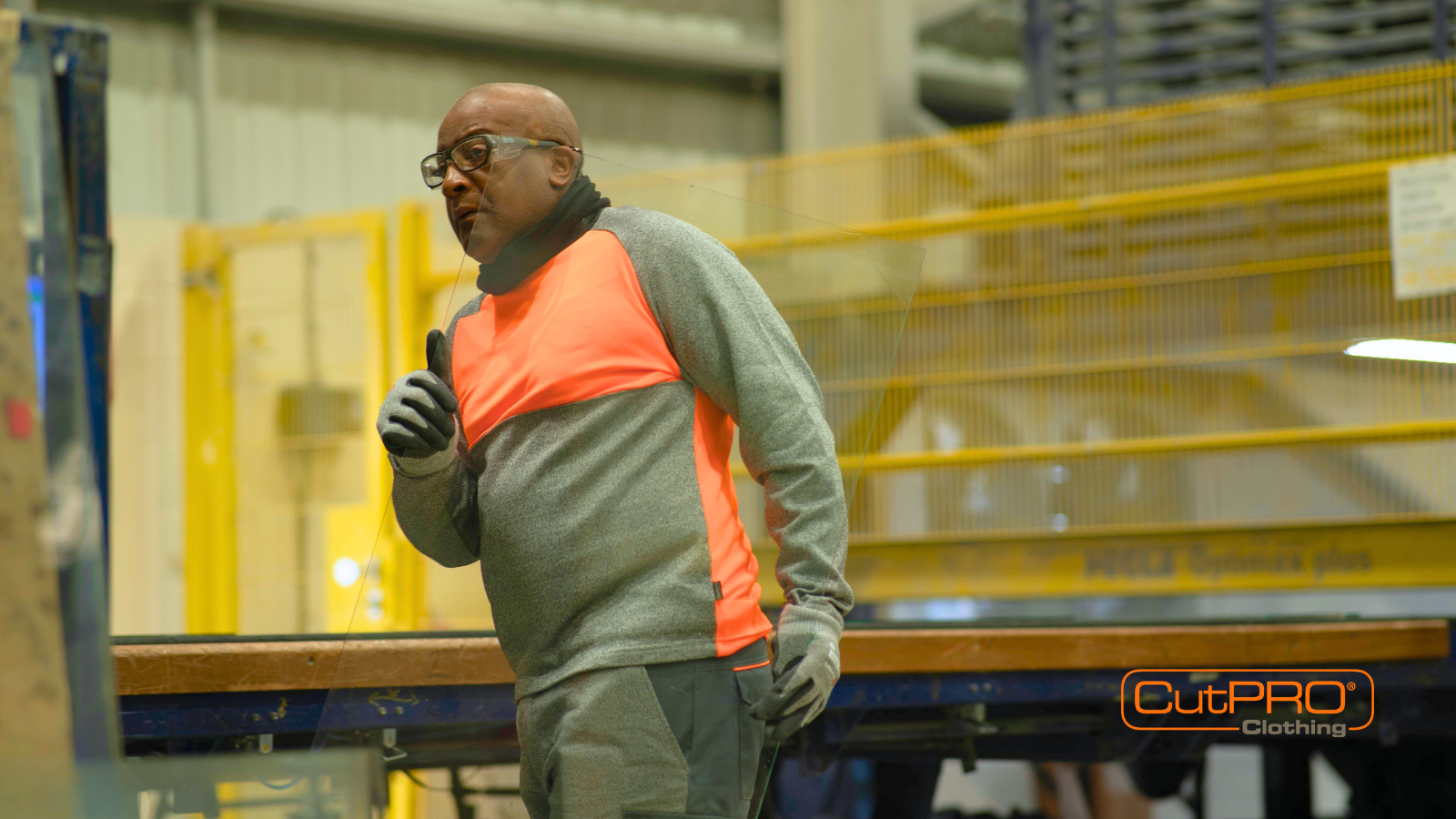
CutPRO® Solutions for the Glass Industry
CutPRO® was made to fulfil a simple goal, which is to provide the safest protection for workers in high-risk environments. Cut protective clothing should be designed to mitigate hazards and prevent injury, without compromise.
For the glass industry, that means garments and accessories constructed from high-performance fibres designed to deliver certified cut and abrasion resistance at the levels glass handling demands.
It means products that have been tested and rated to the highest standards so that safety managers, procurement teams, and compliance auditors can trust in the safety of their teams. At CutPRO®, we use a proprietary fabric engineered by our team called Cut-Tex® PRO, The Ultimate Cut Protection ™.
CutPRO® provides a full suite of protection for glass manufacturing environments:
Cut-resistant sleeves for workers at cutting stations, float lines, and glass-handling operations, protecting the forearms where contact risk is highest
Cut-resistant aprons for workers who lean over processing surfaces and glass sheets during cutting, grinding, and finishing operations
Cut-resistant jackets and coveralls for more complete body protection in float glass processing or where total body risk is assessed
Hand and wrist protection to complement body garments and provide seamless coverage at the points of highest risk
Every CutPRO® product is selected for its specific performance characteristics, cut level, abrasion resistance, body coverage, and wearability to match the actual risk profile of the role, not a generic specification.
Protecting the People Behind the Glass
The Middle East's glass industry will continue to grow. The construction pipelines that are driving demand are measured in decades, not years. As production capacity expands and the workforce grows with it, the number of workers exposed to cut, and laceration risk will increase accordingly.
For businesses operating in this environment, whether in Egypt, Saudi Arabia, the UAE, or across the wider region, the investment case for high-quality cut-resistant PPE is not simply about compliance. It is about operational continuity. Fewer injuries mean less unplanned downtime, lower workers' compensation liability, smoother audits from international clients, and a workforce that feels valued and protected.
Increasingly, that investment case is also about reputation. International buyers and partners expect demonstrable safety standards. Facilities that can evidence a robust, standards-compliant PPE programme, with documented garment specifications, cut ratings, and worker compliance, are better positioned in a competitive market.
The glass that sheathes the Middle East's skylines is a product of extraordinary industrial ambition. The people who make it deserve protection that matches.
Speak to a Cut-Protection Specialist
If you're responsible for worker safety in a glass manufacturing environment, whether you're assessing PPE for the first time, upgrading from lower-specification products, or standardising across a multi-site operation then CutPRO® can help.
Contact our team to request product samples, technical data sheets, or a consultation on cut protection for your facility.
About the Author
Jim Still is the Director of Business Development at PPSS Group, which oversees the entire group and its brands CutPRO®, SlashPRO®, BitePRO® and STRONGTEX®.
Jim is a former Royal Marine Commando having served in Afghanistan and Iraq before working as a Private Military Contractor where he specialised in risk management and close protection intelligence.
Since joining PPSS Group in 2016, Jim has focused on developing and expanding protective solutions that help frontline professionals operate more safely in high-risk environments.
